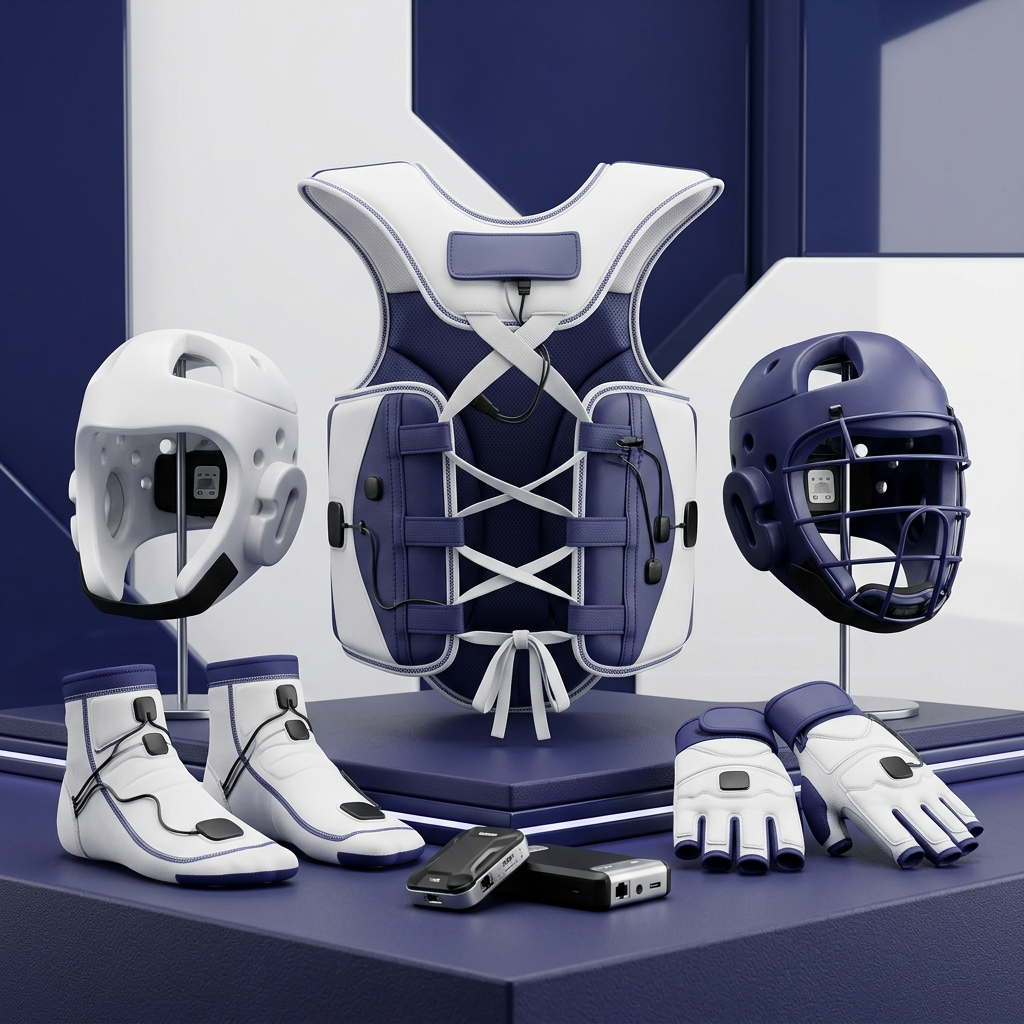
The Triad of Electronic Scoring
For years, World Taekwondo competitions were defined by a grueling duopoly: Daedo and KPnP. Now, with the official validation of Waychamp, a third titan has entered the arena. This Ultimate PSS Showdown: Waychamp vs Daedo vs KPnP provides a definitive, comparative analysis of how each system fundamentally interprets the physical art of Kyorugi.
Choosing—or adapting to—one of these systems is no longer just an equipment preference; it dictates an athlete's entire biomechanical destiny on the mat.
"Daedo rewards volume. KPnP rewards absolute power. Waychamp rewards geometric precision. Know the system, and you know how to win."
1. Daedo (Gen 3): The Volume King
Daedo has long been the gold standard for Olympic-level Taekwondo, prioritizing fluid motion and continuous engagement.
- The Technology: Daedo relies on a centralized piezoelectric pressure plate combined with relatively sensitive magnetic proximity sensors.
- The Meta It Creates: Because the sensors are relatively forgiving on the *duration* of impact, Daedo heavily favors the "cut kick" (front-leg pushing motion). Athletes can flick, slide, or drag their electronic socks across the Hogu to register points.
- Major Weakness: It is notorious for registering "ghost points" from knee clashes or prolonged clinches, forcing referees to be overly vigilant with holding penalties.

2. KPnP: The Power Purist
KPnP was introduced as the antidote to the "foot fencing" era, demanding genuine force to register a point.
- The Technology: KPnP utilizes rigid, high-threshold localized sensors that require a massive spike in Newton-meters within a split second to validate an impact.
- The Meta It Creates: This system resurrected the back-leg game. Dollyo Chagis (roundhouse kicks) and Dwit Chagis (back kicks) dominate on KPnP because it requires blunt force trauma rather than a grazing magnetic connection.
- Major Weakness: The system is often criticized for being *too* hard. Perfectly placed, technically sound head kicks sometimes fail to register if the flex of the headgear entirely absorbs the impact.
3. Waychamp: The Geometric Precisian
Waychamp, the newest entrant, attempts to find the perfect middle ground by utilizing modern distributed micro-sensor arrays.
- The Technology: A distributed mesh of micro-sensors woven directly into the fabric, requiring a perfect 90-degree perpendicular impact angle coupled with a localized burst of force. Furthermore, it incorporates an accelerometer that rewards high-rebound strikes.
- The Meta It Creates: It completely nullifies the "push kick" by applying a strict 0.15-second impact duration limit. It favors traditional rotational kicks like the KPnP system, but does not require the same brute force. Instead, it demands absolute *structural integrity* and precision upon delivery.
- Major Weakness: The learning curve is brutal. Athletes accustomed to Daedo's forgiving sensors often find themselves repeatedly striking the Waychamp Hogu with no results until they correct their kinetic chain.
Conclusion: Which System Prevails?
There is no objectively "best" system. A long, flexible fighter with high stamina will thrive on Daedo. A stocky, explosive power-kicker will tear through a KPnP bracket. A technically perfect, traditional martial artist will dominate on Waychamp.
The true masters of the sport in 2026 will not be those who complain about the sensors, but those whose tactical fluidity allows them to seamlessly transition between all three standard systems depending on the tournament draw.