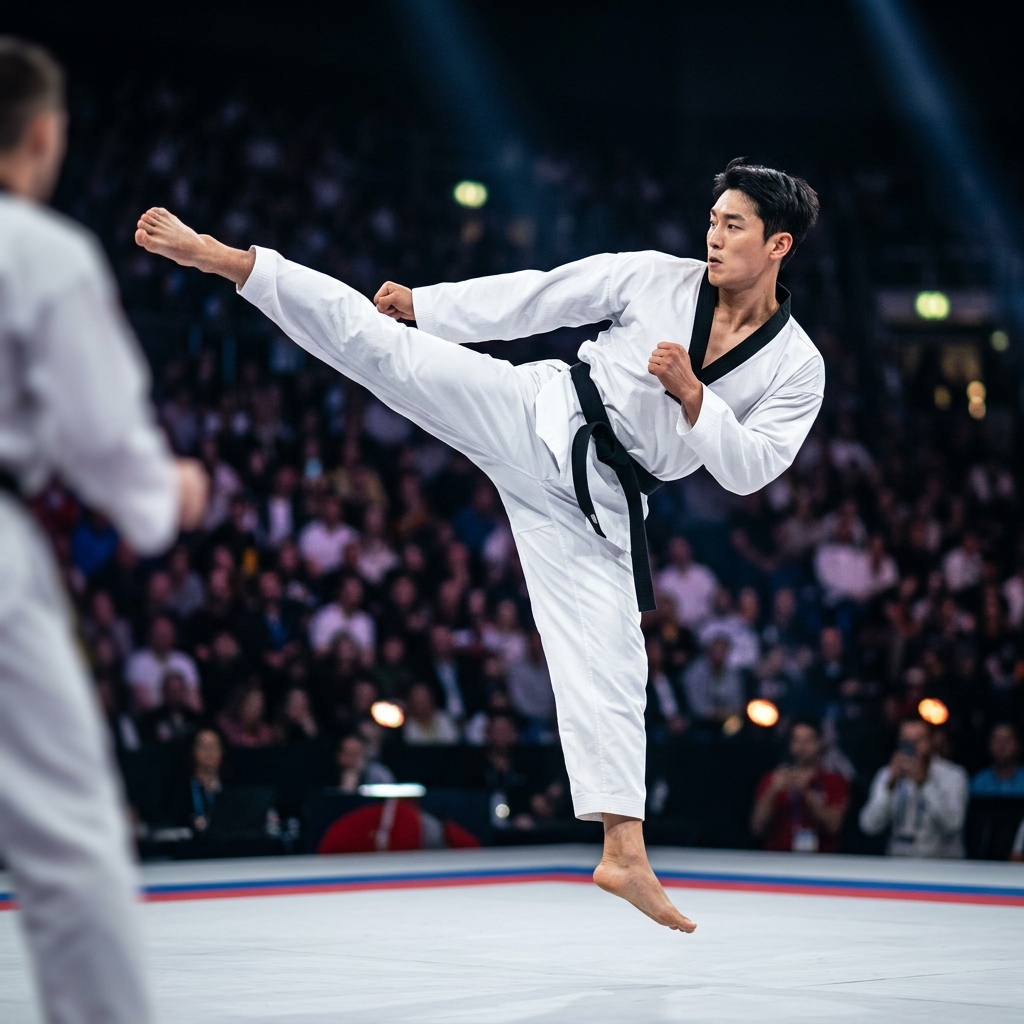
The Mathematics of the Penalty
In the original era of Taekwondo, a Kyong-Go (warning) or Gamjeom (half-point/full-point deduction) was a mark of shame. An athlete only received one if they did something blatantly illegal, like punching the face.
In the modern Daedo/KPnP era, the Gamjeom is a highly weaponized mathematical tool. Because matches are incredibly tight and defensive structure is so high, games are frequently won by a score of 4-3, where 3 of the winner's points came from the opponent stepping out of bounds.
"If you cannot kick them to score a point, push them until they make a mistake. A point gained from a penalty counts exactly the same on the scoreboard."
The Weaponized Boundary Line
The most common tactical penalty in modern Kyorugi is "Crossing the Boundary Line." Elite fighters will intentionally sacrifice their own stamina to aggressively walk their opponent backward, pinning their heel a centimeter from the line.
The attacker does not even try to throw a scoring kick. They will throw a heavy, high-volume flurry purely into the opponent's guard. The sheer physical pressure forces the defender to take one half-step backward to balance, triggering the boundary violation and gifting the attacker a free point. This is called "Mining for Gamjeoms."
The Clinch Exploitation (Holding)
The second most weaponized penalty is Holding. If Fighter A is taller and wants to keep distance, and Fighter B crashes into the clinch, Fighter A will intentionally "limp arm"—dropping their arms completely to their sides.
This creates a visual illusion for the center referee. Fighter A is not fighting back. Therefore, it visually appears that Fighter B is aggressively grabbing and bear-hugging Fighter A to stay inside. Within 3 seconds, the referee blows the whistle and penalizes Fighter B for holding, despite Fighter A actually initiating the stall by refusing to engage. It is theatrical acting, and it works.
Conclusion
A fight is governed by the ruleset. Refusing to utilize tactical penalties out of "honor" is the fastest way to lose the World Championships. Athletes must study the WT rulebook like a lawyer studies a contract, searching for every exploitable loophole.