
The Need for Evolution
For decades, the standard WT Recognized Poomsae roster consisted exclusively of the 8 Taegeuk patterns (for colored belts) and the 9 Yudanja patterns (for black belts, from Koryo to Ilyeo). While these patterns are foundational, they were designed decades ago and do not fully showcase the extreme athleticism of modern Taekwondo athletes.
To keep the sport visually engaging and to offer new challenges for elite competitors, WT commissioned the creation of the New Poomsae series. These patterns represent a massive evolutionary leap in technical complexity.
"The traditional Poomsae are the roots of the tree. The New Poomsae are the flowers—vibrant, complex, and demanding."
Himchari: The Acrobat's Test
Himchari translates roughly to "forceful movement" or "energetic flight." It was designed specifically to bridge the gap between traditional recognized Poomsae and Freestyle.
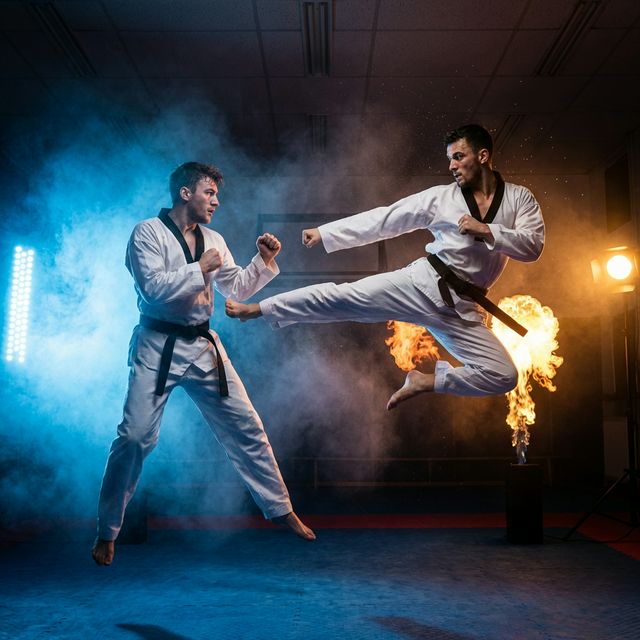
- The Aerial Component: Himchari is famous for integrating jumping spinning kicks directly into a rigid format. Unlike Freestyle where athletes can choose their acrobatics, Himchari mandates specific, highly technical airborne strikes that must land in a perfect, stable stance.
- Asymmetrical Rhythms: The pattern breaks away from the traditional 4/4 marching rhythm, requiring sudden, violent bursts of speed followed by extended, agonizingly slow tension holds, testing the athlete's fast and slow-twitch muscle control simultaneously.
Saebyeol: The New Star
Saebyeol, meaning "New Star," is designed for the younger, highly agile demographic (specifically targeting the Junior and Under 30 divisions). It incorporates defensive tactics that are rarely seen in older patterns.
It features rapid evasion footwork, multiple target tracking (Si-seon shifting rapidly between three distinct attackers), and devastating low-line attacks. It requires an athlete to maintain a drastically lower center of gravity than patterns like Koryo.
The Integration into Tournaments
Currently, the New Poomsae are primarily contested at the elite international level (World Championships, Asian Games), often used as tie-breaker patterns or semi-final requirements. However, as coaching methodologies catch up, we will inevitably see Himchari and Saebyeol trickle down into national and state-level competitions.
Conclusion
The introduction of the New Poomsae proves that traditional martial arts can evolve without losing their identity. Athletes who master these new patterns will possess a distinct biomechanical advantage as WT continues to push the boundaries of extreme athletic presentation.