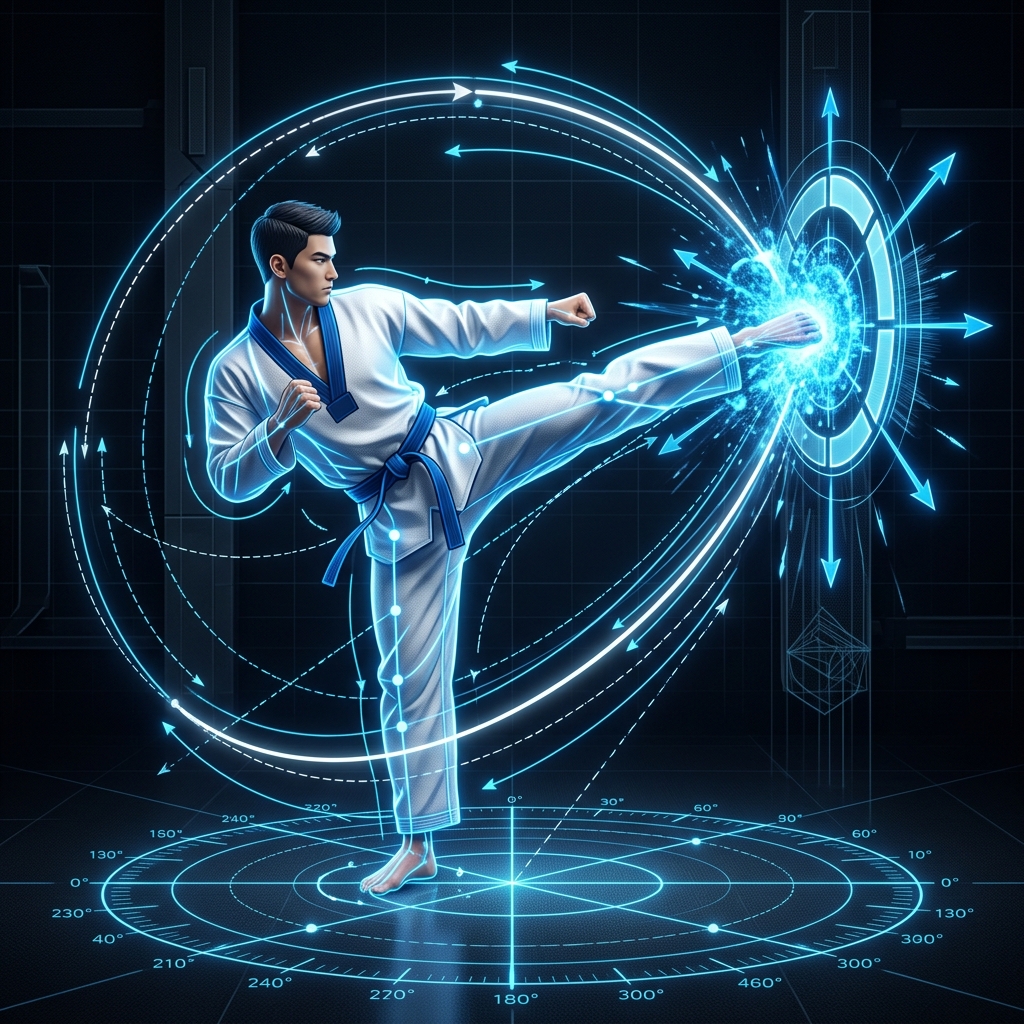
The Ultimate Stability Test
Ask any elite Taekwondo athlete which movement they hate practicing the most, and the answer is almost universal: the Hakdari-Seogi (Crane Stance) sequences in the Poomsae Pyongwon. It consists of balancing on one leg while the other knee is chambered high, combined with complex, slow tension arm movements.
"A tremor in your hand might cost you 0.1 points. A tremor in your Crane Stance might cost you the medal."
The Mechanics of the Hakdari-Seogi
The Hakdari-Seogi is not a resting pose; it is a highly active, muscularly demanding structure.
- The Supporting Knee: This is where most athletes fail. The supporting knee must be bent deeply to lower the center of gravity. If the supporting leg is straight, the stance becomes top-heavy and incredibly vulnerable to the slightest micro-shift in body weight.
- The Chambered Foot: The instep of the chambered foot must be placed perfectly alongside the inner knee of the supporting leg. The toes should point downward. It should look sharp and intentional, not like a flamingo casually resting its leg.
- Core Locking: The arms are executing a slow Diamond Block (Keumgang Makki) and then a slow Side Strike. As the arms move laterally, the center of gravity shifts. To prevent falling over, the athlete's oblique muscles must fire asymmetrically to counter-balance the weight of the moving arms.
The Psychological Battle of Pyongwon
Because Pyongwon takes place almost entirely on a single lateral line, any loss of balance is magnified ten-fold to the judges sitting straight ahead.
During the slow tension phase of the Crane Stance, the athlete's leg will inevitably begin to burn due to lactic acid buildup in the quads. The psychological urge to rush the movement to relieve the pain is immense. Athletes must train their minds to separate the pain in their leg from the rhythm in their head, maintaining a stoic, 5-second count while their muscles scream.
Conclusion
The Hakdari-Seogi is the crucible that separates good black belts from world-class masters. It requires a perfect marriage of unilateral leg strength, deep core stability, and unbreakable psychological fortitude. Master the Crane Stance, and you master Pyongwon.