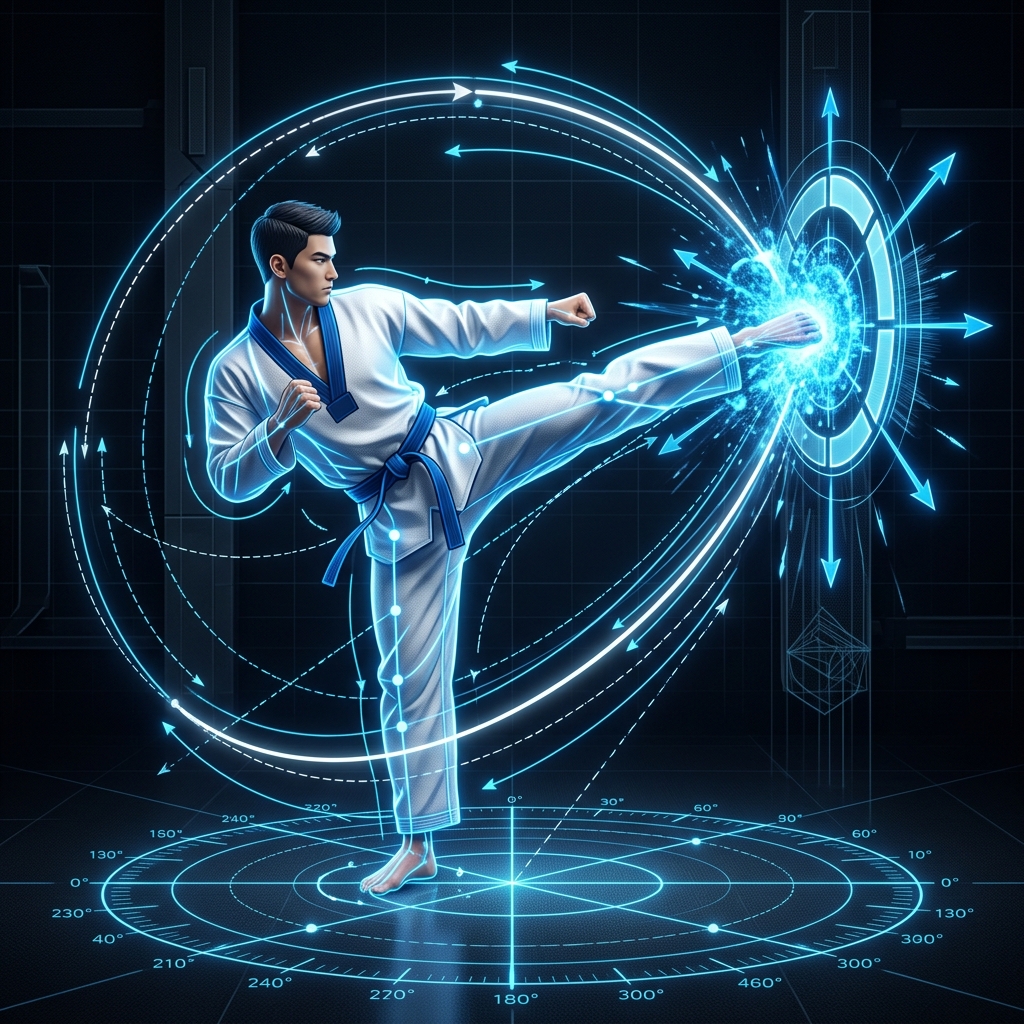
The Illusion of Slowness
To an untrained observer, the slow pushing motions in patterns like Koryo or Sipjin look like the easiest parts of the routine. They require no jumping, no high kicking, and no blinding speed. However, elite Poomsae athletes will tell you that the Slow Tension Movements are the most physically exhausting sequences on the mat.
"If your slow tension move doesn't make your core burn and your hands shake, you are just pantomiming. You are not performing Taekwondo."
The Concept of Co-Contraction
If you slowly extend your arm into a punch, it requires very little energy. To turn that movement into a scored Poomsae technique, you must utilize Muscular Co-Contraction. This means simultaneously firing both the agonist (the pushing muscles, like the triceps and chest) and the antagonist (the pulling muscles, like the biceps and lats).
You are essentially fighting your own body. By fully flexing the biceps while simultaneously trying to straighten the arm using the triceps, the limb moves forward at an agonizingly slow pace, generating immense internal pressure and a visible kinetic "shake."
The 5-Second Rule
In World Taekwondo judging, slow tension movements have a mathematically strict time requirement: exactly 5 seconds. Judges will silently count in their heads. If you finish the push in 3.5 seconds, it is a rhythm deduction. If you milk it to 7 seconds, it is a rhythm deduction.
- The Breath Extrusion: You cannot hold your breath for 5 seconds while under maximum isometric load (this spikes blood pressure and causes faintness). Instead, the breath must be extruded slowly through pursed lips or a clenched jaw, acting as the metronome for the movement. The breath must run out at the exact millisecond the arms lock into final position.
- The Kinetic Chain: The tension cannot only exist in the arms. It must originate in the floor. The athlete's toes must grip the mat, the glutes must be locked, the core compressed, and that tension travels up the spine and out through the fists. A tense arm attached to a relaxed torso earns a low Presentation score.
Conclusion
Slow tension movements are the ultimate expression of control. They prove to the judges that your power does not just come from momentum, but from deep, structural muscular command. Mastering co-contraction transforms a boring pause into the most dramatic sequence of your pattern.